
Most important takeaways…
- Most BSN-to-DNP programs take 3 to 4 years full time, while MSN-to-DNP programs typically require 2 to 3 years.
- AGACNP tracks often run longer because acute care clinical placements are among the hardest to schedule.
- Working nurses on part-time schedules should plan for 4 to 7 years depending on entry pathway and credit load.
- Transferring 500 to 600 master's clinical hours into a post-MSN DNP can shorten your timeline by up to a year.
Most DNP programs take between three and four years to complete, though actual timelines range from as few as two years for an MSN-prepared nurse practitioner enrolling full-time in a post-master's track to six years or longer for a BSN-prepared nurse balancing full-time work with part-time coursework. The difference comes down to four variables: your entry degree (BSN, MSN, or ADN), whether you enroll full-time or part-time, how many clinical hours your specialty demands, and how quickly you can complete your DNP scholarly project.
AGACNP students often face longer timelines than family or psych-mental health NP tracks because critical-care clinical placements are harder to schedule. Working nurses who cannot afford to reduce their hours typically add one to two years to published completion estimates. If you are still mapping out the full journey from RN to advanced practice, our guide on how to become a nurse practitioner covers every step along the way.
The credential itself is standardized by AACN guidelines, but the path to earning it is not. Schools differ sharply in credit requirements, clinical hour policies, and whether they allow transfer credit from prior graduate work.
How Long Are Most DNP Programs?
Most BSN-to-DNP programs run 3 to 4 years when completed full-time, while MSN-to-DNP programs typically take 1 to 2 years at full-time pace. These national timelines reflect the median experience across the 452 DNP programs operating in 20252, but your individual journey will depend on your starting credentials, specialty track, and whether you enroll full- or part-time.
Why 'It Depends' Is a Real Answer
Credit loads vary widely by entry point. Post-MSN DNP programs usually require 30 to 45 credits, since you already hold advanced practice coursework and clinical hours from your master's degree. Post-BSN programs, by contrast, demand 70 to 90+ credits because they bundle specialty NP training, advanced pathophysiology, pharmacology, assessment, and the DNP project into a single curriculum. That difference alone accounts for 18 to 24 months of extra coursework.
Clinical hours compound the variation. The American Association of Colleges of Nursing mandates a minimum of 1,000 post-baccalaureate supervised practice hours for DNP graduates.3 If you enter with an MSN and already earned at least 500 clinical hours, you'll complete roughly 500 additional hours during your DNP program. BSN-to-DNP students, however, complete all 1,000 hours during the program, which means securing preceptors, scheduling clinical rotations around work, and potentially extending your timeline by a semester or two.
Catalog Timelines vs. Real Completion Times
AACN data shows that actual median time-to-degree often exceeds catalog estimates by one to two semesters, especially for part-time students juggling work and family.2 Programs publish 36-month or 24-month plans assuming you maintain continuous enrollment and never need a lighter course load. In practice, many working nurses take an extra summer term or reduce credits during particularly demanding clinical rotations, pushing graduation by six to twelve months.
How Specialty Track Affects Program Length
Your specialty matters. Family Nurse Practitioner, Psychiatric-Mental Health Nurse Practitioner, Nurse Midwifery, and Acute Care Nurse Practitioner tracks each carry distinct clinical and didactic requirements. AGACNP programs, for instance, often require intensive critical-care rotations that may be harder to schedule part-time, potentially adding a semester. If you already hold an MSN and want to add a new specialty before pursuing your DNP, post-master's certificate FNP programs can help you bridge the gap. PMHNP tracks may offer more flexible telehealth preceptorships that accelerate your timeline. FNP tracks typically follow the median 3 to 4 year post-BSN or 1 to 2 year post-MSN pattern, while midwifery programs may extend slightly due to birth-attendance requirements.
Understanding these variables upfront helps you set realistic expectations and choose a program structure that aligns with your life.
DNP Timeline by Entry Pathway: BSN vs MSN vs ADN
The number of years you'll spend in a DNP program depends heavily on the nursing degree you already hold. While BSN and MSN entry paths both lead to the same terminal credential, the credit and time requirements differ sharply. Understanding these pathways lets you pick a pace that fits your life and career stage.
BSN-to-DNP: The Standard Full-Time Timeline
For the majority of nurses, the Bachelor of Science in Nursing is the launching point. This direct-entry path is the most common and the one most schools design their curriculum around. A typical BSN-to-DNP program requires around 87 credits and a minimum of 1,000 clinical hours, though credit totals can range from 70 to over 90 depending on the specialty track and the school's requirements.1
- Credits: 70, 90+ credits
- Clinical hours: 1,000 hours
- Full-time completion: 3, 4 years
- Part-time completion: Often extends to 4, 5 years
BSN-to-DNP students begin with advanced practice core courses before moving into doctoral leadership and project work. Because this is the most established route, you'll find the widest variety of online and on-campus options, as well as more flexibility in pacing.
MSN-to-DNP: A Shorter Path for Master's-Prepared Nurses
If you already hold a Master of Science in Nursing, you can bypass foundational coursework and jump directly into doctoral-level study. MSN-to-DNP programs typically require around 30 credits and the same 1,000 clinical hours, but many programs will accept up to 500 hours from your master's clinical training, reducing the time commitment further.2 If you're still weighing whether to pursue an MSN first, you can explore best online MSN nurse practitioner programs to find the right fit before deciding on a DNP.
- Credits: 30, 45 credits
- Clinical hours: 1,000 hours (with possible transfer credit)
- Full-time completion: 2, 3 years
- Part-time completion: Typically 3, 4 years
This path is designed for working APRNs who want to earn their terminal degree without repeating content they've already mastered. The focus is on evidence-based practice, systems leadership, and a final DNP scholarly project.
ADN-to-DNP: When You're Starting with an Associate Degree
This pathway is far less common and almost never a single, streamlined program. Because an associate degree leaves a gap in both academic credits and clinical experience, you'll need to complete a BSN or bridge component first.3 Direct ADN-to-DNP options are rare at accredited schools; most students first earn a BSN and then apply to a BSN-to-DNP program.
- Credits: 100+ including all bridge coursework
- Clinical hours: 1,000 hours at the DNP level, plus any required for the intermediate degree
- Full-time completion: 5, 6+ years
- Part-time completion: 6, 8 years
Some institutions advertise ADN-to-DNP tracks, but they are often structured as sequential BSN completion followed by the DNP. If you hold an ADN and aim for the DNP, expect a longer journey that requires careful planning and likely a stepwise approach.
Questions to Ask Yourself
AGACNP DNP Program Length: What to Expect
Choosing an Adult-Gerontology Acute Care Nurse Practitioner (AGACNP) track adds a layer of complexity that most other DNP specialties do not share: the clinical sites you need are among the hardest to schedule, and that single factor can shape your entire timeline. Understanding what drives these timelines will help you plan realistically and avoid frustrating surprises.
General AGACNP DNP Timelines
AGACNP-track DNP programs generally take three to four years when you enter with a BSN and roughly two to three years from an MSN. Those ranges look similar to what you see in FNP or PMHNP tracks on paper, but the real-world completion picture is often different. Acute care rotations must take place in settings like ICUs, emergency departments, and specialty inpatient units, and securing those placements can push your finish date further out than you initially expected. If you are still exploring the AGACNP pathway, reviewing adult gerontology nurse practitioner programs online can help you compare options side by side.
What Named Programs Look Like
Rush University's AGACNP DNP program offers a useful benchmark. The program requires 75 credits and is designed for completion in roughly 42 months, delivered in a hybrid format.1 Students begin part-time and transition to full-time coursework as they progress.1 Rush does not offer an accelerated version of this track, and the structure reflects the realities of fitting intensive acute care clinical hours into a schedule that already includes didactic and DNP project work.1
Other well-known programs at schools such as Columbia, Duke, and the University of Illinois Chicago also offer AGACNP DNP pathways, and their published timelines tend to land in a similar range. Exact credit totals and completion estimates vary by entry point and enrollment status, so prospective students should confirm current requirements directly with each program. Credit totals across AGACNP DNP programs commonly fall between roughly 70 and 90 credits depending on whether you enter at the BSN or MSN level.
Why AGACNP Timelines Often Run Longer
The biggest driver of extended timelines in AGACNP programs is clinical placement availability. Unlike primary care rotations, which can take place across a wide network of outpatient clinics and community health centers, acute care rotations require hospital-based settings with specific patient populations and acuity levels. Consider some of the factors at play:
- Limited site capacity: ICUs and EDs can only accommodate a finite number of students at one time, and many hospitals give priority to their own affiliated programs.
- Preceptor shortages: Finding a credentialed acute care preceptor who can dedicate time to teaching while managing critically ill patients is a genuine bottleneck at many institutions.
- Seasonal and geographic constraints: Clinical availability may fluctuate based on hospital census, staffing levels, or regional demand, making certain semesters harder to fill than others.
These factors mean that even students who stay on top of coursework can find themselves waiting a semester or more simply because the right clinical slot has not opened up.
Accelerated and Year-Round Options
Some schools do offer year-round enrollment or compressed course sequences for AGACNP students, but true accelerated AGACNP DNP programs remain uncommon. Rush, for example, does not provide an accelerated pathway for this track.1 Where accelerated options do exist, expect trade-offs: heavier course loads during each term, mandatory summer enrollment, and little to no break between semesters. For working nurses, those demands can be difficult to sustain over multiple years.
Before committing to an accelerated plan, ask the program directly how clinical placements are handled during compressed timelines. If the school cannot guarantee timely acute care site assignments, an accelerated academic schedule may not actually shorten your overall time to degree. A realistic conversation with an admissions advisor, ideally one who works specifically with AGACNP students, can save you from building a plan around a best-case scenario that rarely materializes. For nurses who already hold an MSN and want to add acute care credentials without a full DNP, online post-master's ACNP certificate programs may be worth exploring as an alternative pathway.
The bottom line: AGACNP DNP programs are achievable and rewarding, but they require honest planning around the clinical logistics that make this specialty unique. Budget a little extra time in your mental timeline, and you will be far less stressed if a placement takes an extra cycle to lock in.
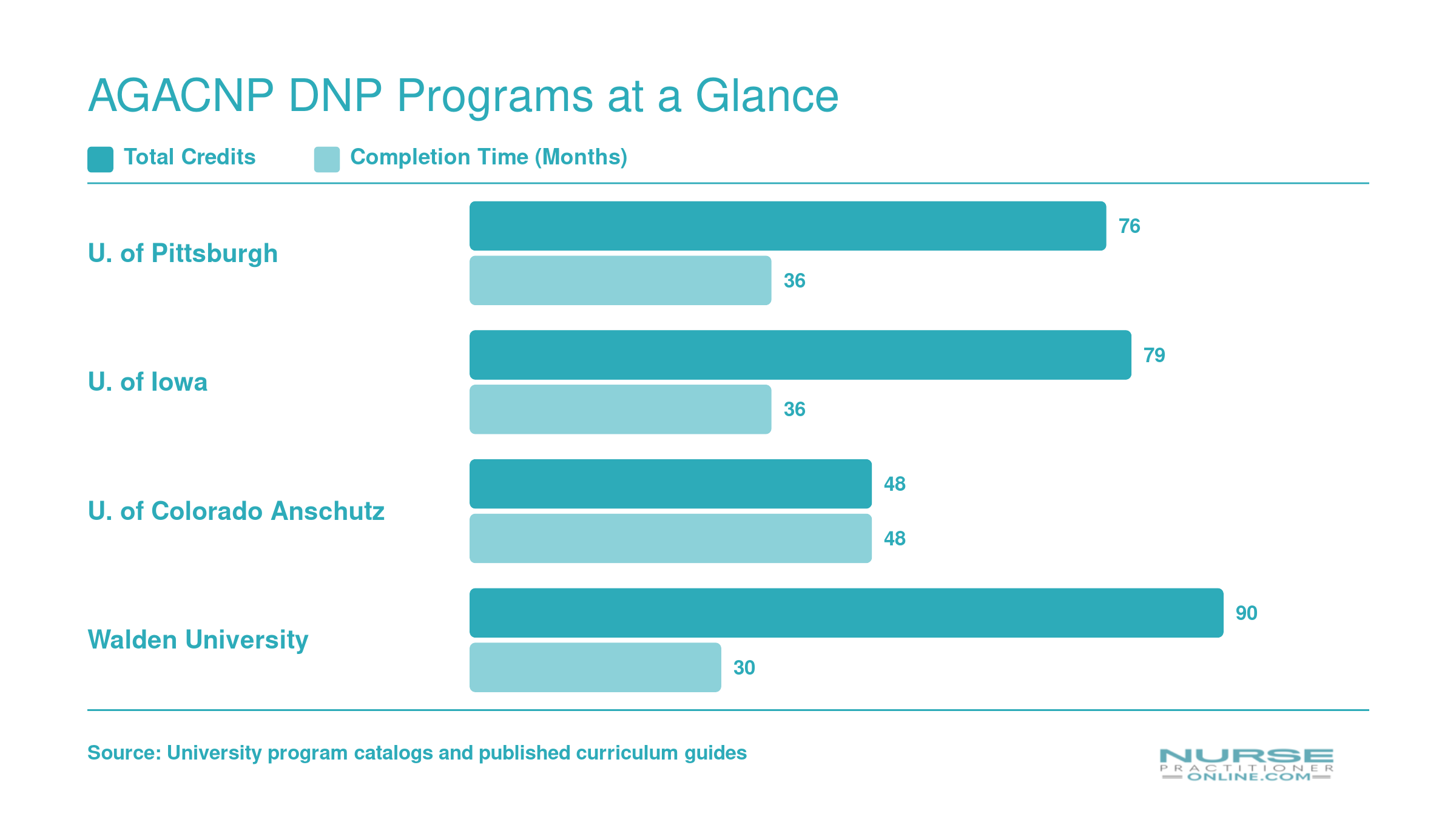
AGACNP DNP Programs at a Glance
AGACNP DNP program requirements vary widely depending on the school, entry pathway, and credit system. The comparison below shows published credit totals and expected completion timelines at four universities. Keep in mind that Walden University uses quarter credits, so its total appears higher but covers a similar scope of study.
Full-Time Vs. Part-Time: Realistic Timelines for Working Nurses
Whether you finish your DNP in three years or seven comes down to one practical decision made early: how many credits can you realistically carry each semester while keeping your job, your license, and your sanity intact.
What Full-Time Actually Looks Like
Full-time DNP students typically complete BSN-to-DNP programs in three to four years, and MSN-to-DNP programs in roughly one and a half to two years. That pace assumes a heavier course load each term, sometimes alongside clinical hours, which is genuinely demanding for anyone holding a nursing position at the same time. Some accelerated programs compress the BSN-to-DNP into around 40 months2, and a few schools push that envelope further. San Jose State University, for example, offers its DNP in just five semesters with an online and on-site intensive format, though that program does not offer a part-time track, so it requires a real commitment to the full-time pace.3
Full-time enrollment works best for nurses who can reduce their clinical hours, have strong family support systems, or are entering a program with cohort-based scheduling that builds structure around the workload.
The Part-Time Reality for Working Nurses
Most working nurses choose the part-time path, and that is a completely reasonable choice. BSN-to-DNP programs can stretch to six or seven years at a part-time pace, which sounds long until you consider that you are keeping your income, your benefits, and your professional momentum the entire time. Spreading the load also gives you more bandwidth for the DNP project, which is typically the most time-intensive component in the final stages of the program.
Not every school publishes their part-time versus full-time completion data openly. The American Association of Colleges of Nursing tracks national completion trends across DNP programs, and those reports can help you benchmark what is typical. Individual program advisors are often your best resource for honest, cohort-level data on how long working nurses actually take to finish.
How to Find the Right Fit for Your Schedule
Before you apply anywhere, ask specific questions:
- Scheduling format: Does the program use weekend intensives, fully asynchronous courses, or hybrid models that require campus visits?
- Completion window: What is the maximum time allowed to finish, and does the program have data on average completion for part-time students?
- Credit load flexibility: Can you adjust your pace semester by semester based on work demands?
Program websites often list curriculum and scheduling details in their admissions sections. If you are still early in the process and want guidance on getting started, our step-by-step guide on how to enroll in NP school online walks you through the basics. Peer-reviewed journals like the Journal of Nursing Education and Nursing Education Perspectives also publish research on DNP attrition and completion patterns that can give you a realistic picture before you commit. The bottom line is that your timeline should serve your life, not the other way around.
How Clinical Hours Affect Your DNP Timeline
Some DNP students finish their didactic coursework on schedule, only to wait months for a clinical placement. Others secure all their preceptors before orientation ends and move through the program like clockwork. The difference isn't luck. It's understanding how clinical requirements, placement logistics, and program structure interact to shape your timeline.
The 1,000-Hour Standard and What You Already Have
The American Association of Colleges of Nursing requires 1,000 post-baccalaureate clinical hours for DNP practice-focused programs. If you're entering with a BSN, you'll complete all 1,000 hours during your DNP studies. MSN-prepared nurses who already hold NP certification typically transfer 500 to 600 hours from their master's program, leaving 400 to 500 new clinical hours to complete. That difference can shave six months to a year off your total timeline, assuming your MSN clinical experiences are documented and accepted by the new program.
Ask admissions directly how many hours you'll transfer and how they verify prior clinical documentation. Some schools require original syllabi, preceptor signatures, and site letters dating back years.
Placement Logistics Can Delay Progress by a Semester or More
Securing clinical sites and preceptors is the single biggest timeline wildcard in DNP education. Urban areas with multiple nursing schools face fierce competition for the same hospital units. Acute care specialties like AGACNP often require ICU, stepdown, or emergency department placements, and many facilities limit student slots or require months of credentialing paperwork.
Geographic restrictions compound the challenge. If you live in a rural state or travel-limited area, your program may struggle to place you within a reasonable distance. Some students wait an entire semester for an appropriate AGACNP preceptor to become available. Others accept placements two hours from home, adding commute time and childcare costs to an already packed schedule.
Didactic-First vs. Integrated Models
Programs structure clinical progression differently. Some front-load didactics in years one and two, then back-load all clinical rotations in the final year. This model lets you focus on coursework early but compresses placement logistics into a narrow window. Other programs integrate clinicals throughout, pairing each advanced practice course with concurrent field hours. Integrated models distribute placement risk but require you to juggle patient care, coursework, and employment simultaneously from day one.
Neither model is inherently faster, but the structure affects how linearly you can progress. A single placement delay in an integrated program might push back one course. In a back-loaded model, it can stall your entire final year.
Questions to Ask Before You Enroll
Before you commit, ask each program:
- What is your on-time clinical placement rate for students in my specialty?
- Do you provide preceptor matching, or am I responsible for finding my own sites?
- What happens if a placement falls through mid-semester?
- How many students are currently waiting for clinical slots?
Programs with dedicated clinical coordinators, established hospital partnerships, and transparent placement data help you stay on track. Programs that hand you a preceptor list and wish you luck often add months to your degree.
Online Vs. On-Campus DNP: Does Format Change Program Length?
One of the most common questions working nurses ask is whether choosing an online DNP program will speed up or slow down their path to graduation. The honest answer: format alone rarely changes how many credits or clinical hours you need. What it does change is your scheduling flexibility, which can indirectly shorten or extend your timeline depending on your circumstances.
Pros
- Online programs often allow year-round enrollment and accelerated pacing, letting motivated students shave semesters off their timeline.
- Eliminating commute time frees up hours each week that working nurses can redirect toward coursework and study.
- Online formats remove geographic barriers, giving nurses in rural or underserved areas access to programs they could not otherwise attend.
- On-campus cohort models tend to keep students on pace with built-in accountability and structured milestone deadlines.
- Campus-based programs often have stronger clinical placement support through established hospital affiliations, reducing preceptor search delays.
- In-person learning offers networking and mentoring advantages that can benefit your career well beyond graduation.
Cons
- Online students must still complete all clinical hours in person, so the format does not eliminate hands-on time requirements.
- Securing a qualified local preceptor independently can cause significant timeline delays for online students, especially in competitive metro areas.
- Online learners may experience less structured peer accountability, making it easier to fall behind without a cohort pushing them forward.
- On-campus programs often have rigid scheduling that forces working nurses into part-time enrollment, potentially adding a year or more.
- Geographic limitations mean on-campus students may not find a nearby school offering their preferred specialty track, such as AGACNP.
- Campus-based schedules built around daytime classes can conflict directly with hospital shift work, creating logistical challenges for bedside nurses.
Credits, Courses, and the DNP Project: Understanding the Workload
Most BSN-to-DNP programs require between 70 and 90 total credit hours, while post-master's (MSN-to-DNP) tracks typically range from 30 to 43 credits. That gap alone can shift your timeline by two or more years, so understanding how credits, coursework, and the DNP project fit together is essential before you commit.
How Credit Loads Vary Across Programs
Credit totals depend on your entry pathway, your chosen specialty, and the individual school's curriculum design. The American Association of Colleges of Nursing (AACN) publishes the DNP Essentials document, which outlines the competency domains every nursing program accreditation must address, but it does not dictate a fixed number of credits. Each university translates those essentials into its own course sequence, elective options, and clinical requirements. That means two fully accredited BSN-to-DNP programs can differ by 15 or more credits.
To get an accurate picture, review the published curricula on multiple schools' official program pages or registrar sites. Look for a semester-by-semester plan of study and compare:
- Total didactic credits versus clinical credits
- Whether transfer credits or prior certifications reduce the load
- How many elective or cognate credits are built in
- The number of credits assigned specifically to the DNP project
The DNP Project: What It Really Involves
The DNP project (sometimes called the scholarly project or capstone) is not a traditional dissertation, but it is still the most time-intensive single component of the degree. Programs typically allocate three to nine credits across two to four semesters for project coursework, which covers topic development, IRB or quality-improvement approval, implementation, data analysis, and final defense.
Project timelines are where many students experience delays. Common bottlenecks include slow site or IRB approvals, difficulty recruiting participants, and faculty committee scheduling. These issues are well documented in peer-reviewed nursing education journals and in completed DNP project manuscripts available through academic databases like ProQuest. Searching those sources can give you realistic expectations for how long similar projects took at various institutions.
Getting the Inside Story
Published program information only tells part of the story. Admissions offices and program directors often track internal data on average time to project completion, pass rates, and the most frequent causes of delay. This information is rarely posted on a school's website but is usually available if you ask directly. If you are considering a family nurse practitioner concentration, for example, comparing best online DNP FNP programs side by side can reveal significant differences in project timelines. Before enrolling, reach out with specific questions:
- What is the average number of semesters students spend on the DNP project?
- How many students finish within the published program timeline?
- What support structures exist when students hit project roadblocks?
For broader context on the profession's salary and employment outlook, the Bureau of Labor Statistics (BLS) publishes data on nurse practitioner roles, though it does not break down outcomes by individual program or credit total.
Investing an afternoon comparing curricula, reading completed DNP projects, and contacting program staff can save you months of surprises once coursework begins. The workload is manageable, especially for working nurses in flexible online formats, but only when you know exactly what you are signing up for.
Tips to Finish Your DNP Faster Without Burning Out
Finishing your DNP on schedule doesn't mean sacrificing your sanity or your paycheck. By choosing the right program structure and managing your workload strategically, you can shave months off your timeline without adding undue stress.
Start with a Flexible Enrollment Calendar
Programs that offer year-round enrollment (spring, summer, and fall start dates) give you a crucial advantage. If you're ready to begin in January but your only option is a fall start, you've already added six to eight months to your timeline before taking a single credit. Look for programs that let you begin when you're ready, not when the academic calendar dictates. This single decision can reduce your total time to degree by up to a year.
Launch Your DNP Project Early
The capstone project is often the biggest bottleneck in DNP completion. Don't wait until your final year to identify your clinical question, secure a practice site, or begin your literature review. Programs that integrate project coursework early (often in year one or two) let you develop your topic iteratively rather than racing against a graduation deadline. Start thinking about potential topics during your first semester, and use elective or foundation courses to explore the evidence base for your area of interest. This front-loaded approach reduces last-semester panic and keeps you on track.
Maximize Transferred Clinical Hours
If you're entering from an MSN program, document every post-baccalaureate clinical hour meticulously. Many programs will credit 500 or more hours from your master's degree, shortening your DNP clinical requirements significantly. Before you enroll, confirm with the admissions office exactly which experiences count and what documentation they need. Missing this step can mean repeating hundreds of hours you've already completed.
Negotiate Work Flexibility Strategically
Rather than stretching your program across five or six years at a minimal course load, consider negotiating a reduced schedule during your heaviest clinical semesters. Dropping from five shifts to three for one or two terms often costs less in lost income than extending your entire program by a year, and it preserves your momentum. Many nurses find that a temporary reduction beats indefinite part-time enrollment. If you're still weighing specialty options, exploring online DNP acute care nurse practitioner programs can help you compare timelines across focus areas.
Use Summer Terms to Compress Your Timeline
Taking one or two courses each summer can transform a four-year part-time track into a three-year finish without overloading your fall and spring semesters. Summer sessions are typically shorter and more focused, making them ideal for foundational courses, electives, or project milestones. This approach keeps your regular semesters manageable while steadily chipping away at your credit total.
Frequently Asked Questions About DNP Program Length
These are some of the most common questions working nurses ask when planning a Doctor of Nursing Practice degree. The answers below reflect typical timelines, credit ranges, and requirements you will encounter across accredited programs in 2026.
- How long are most DNP programs?
- Most DNP programs take between two and four years to complete. The exact timeline depends on your entry point, enrollment status, and clinical hour requirements. MSN to DNP programs often finish in about two years of part-time study, while BSN to DNP programs typically require three to four years of full-time coursework and clinical practice.
- How long does it take to go from BSN to DNP?
- A BSN to DNP program generally takes three to four years of full-time study. Part-time students should expect four to five years or longer. These programs include both the master's level and doctoral level coursework, plus 1,000 or more total clinical hours and a DNP scholarly project, so the longer timeline reflects the broader scope of preparation.
- Can you complete a DNP while working full-time?
- Yes, many DNP programs are specifically designed for working nurses. Part-time and online formats let you spread coursework across more semesters, though this extends your timeline by one to two years compared to full-time enrollment. Expect to dedicate 15 to 25 hours per week to classes, clinical rotations, and your DNP project on top of your work schedule.
- How many clinical hours are required for a DNP?
- Accreditation standards require a minimum of 1,000 post-baccalaureate supervised clinical hours for DNP completion. If you enter through an MSN to DNP pathway, hours earned during your master's program typically count toward that total, so you may need only 500 to 600 additional hours. BSN to DNP students complete all 1,000 or more hours within the program.
- How long is an AGACNP DNP program?
- An Adult-Gerontology Acute Care Nurse Practitioner DNP program usually takes three to four years from a BSN entry point and roughly two years from an MSN entry point. The acute care specialty requires extensive clinical hours in hospital and critical care settings, which can make scheduling more complex for part-time students and may add a semester or two.
- How many credits is a DNP program?
- DNP programs typically range from 30 to 45 credits for MSN to DNP pathways and 70 to 90 or more credits for BSN to DNP pathways. The higher credit count in BSN to DNP programs reflects the inclusion of master's level courses. Credits for the DNP project, advanced practice core courses, and clinical practica make up the bulk of the curriculum.
- Is an online DNP faster than an on-campus DNP?
- Not necessarily. Online and on-campus DNP programs usually require the same number of credits and clinical hours, so the total timeline is comparable. However, online programs often offer more flexible scheduling, including year-round enrollment and asynchronous coursework, which can help working nurses maintain steady progress and potentially finish on the earlier end of the typical range.