
Most important takeaways…
- NP job growth is projected at 40% between 2024 and 2034, with telehealth roles expanding rapidly.
- The APRN Compact lets multistate licensees treat patients across compact states, but both ends must qualify.
- Medicare generally reimburses NP telehealth visits at 85% of physician rates, while Medicaid and commercial payer rules vary by state.
- Psychiatric mental health and primary care NP specialties are leading telehealth adoption nationwide.
Medicare telehealth utilization among nurse practitioners jumped more than 8,000% in the early months of 2020, and unlike most pandemic-era shifts, it never fully retreated. Six years later, virtual visits remain a permanent billing channel, with the Consolidated Appropriations Act extending key Medicare telehealth flexibilities and most commercial payers maintaining parity policies in some form.
What that permanence looks like in practice depends almost entirely on three variables: the state where your patient sits, the payer footing the bill, and the nurse practitioner specialties you hold. A psychiatric mental health NP in a compact state operates under a very different set of rules than a family NP credentialed only in California, and reimbursement rates can swing by 30% or more between Medicare, Medicaid, and private plans for the same CPT code.
How Telehealth Expansion Has Changed NP Practice Since COVID-19
The telehealth story for nurse practitioners did not end when the public health emergency lifted. What started as an emergency response has evolved into a durable restructuring of how NPs deliver care, with federal and state governments codifying many of the flexibilities that providers and patients quickly came to depend on.
From Emergency Waivers to Lasting Policy
When the COVID-19 public health emergency took effect in 2020, CMS moved quickly to waive longstanding restrictions on Medicare telehealth, allowing NPs to see patients at home, practice without geographic limitations for behavioral health, and bill for audio-only visits.1 Extensions in 2021 and 2022 kept those flexibilities alive while Congress and federal agencies debated which ones deserved a permanent home in policy.
The clearest answers came in the years that followed. Geographic restrictions on behavioral health telehealth were permanently removed, and audio-only visits for behavioral health became a lasting option, not a temporary patch.1 For Medicare broadly, current rules allow NPs to use the patient's home as a distant site, remove frequency limits on telehealth visits, and permit direct supervision through virtual presence rather than in-person oversight.1 Non-behavioral telehealth restrictions are not set to return until 2028, and the current Medicare telehealth extensions run through the end of 2027, giving practices a meaningful runway to plan around.
At Federally Qualified Health Centers and Rural Health Clinics, behavioral health telehealth is now permanently covered. Non-behavioral telehealth payment at those sites has also received extensions, reflecting how central these settings are to the patients NPs disproportionately serve. Understanding how primary care billing and coding works in a telehealth context is increasingly important as these payment policies solidify.
Federal Prescribing Rules: Still in Transition
One area that remains unsettled is controlled substance prescribing via telehealth. Under the Ryan Haight Act, the default rule requires at least one in-person exam before prescribing controlled substances.2 The DEA extended the COVID-era flexibility that waived this requirement, but as of 2025 those extensions are still temporary, not permanent.2 NPs who prescribe controlled substances through telehealth should track DEA rulemaking closely, since the final framework has not been locked in. Staying current on these developments is one reason more NPs are engaging with the nurse practitioner health policy toolkit to advocate for clear, workable rules.
Utilization Has Not Retreated
Utilization data tells the structural story plainly. Telehealth visit volume across the healthcare system remains several times higher than pre-pandemic levels, even after the initial surge settled.3 For NPs specifically, adoption during the pandemic was high, and the trend has stabilized well above where it started.4 Behavioral health and chronic disease management account for the largest share of that sustained activity, which maps closely to where NPs hold nurse practitioner practice authority by state with independent or reduced-supervision status.
The practical implication is straightforward: telehealth is no longer a crisis accommodation. It is a core delivery channel, and the policy infrastructure now reflects that reality.
State-by-State Telehealth Laws and Licensing for NPs
Which states allow nurse practitioners to practice telehealth independently, and how do you find out if yours is one of them?
This is one of the most practical questions you can ask before pursuing a telehealth role, and the honest answer is: it depends on where you hold your license, where your patient is located at the time of the visit, and whether you work under a collaborative agreement. Telehealth does not exist in a regulatory vacuum. The same rules that govern your in-person scope of practice follow you into a virtual visit.
Start With Practice Authority in Your State
States fall into three broad categories when it comes to NP scope of practice: full practice authority, reduced practice, and restricted practice. In full-practice states, NPs can assess, diagnose, order tests, and prescribe without physician oversight. In reduced-practice states, some elements of practice require a collaborative agreement. In restricted states, physician supervision is required across the board.
For telehealth, this matters enormously. A state that requires a collaborative agreement for in-person visits will almost certainly require one for virtual visits too. The modality changes; the regulatory framework generally does not.
The National Council of State Boards of Nursing (NCSBN) maintains an updated map of NP practice authority by state. The American Association of Nurse Practitioners (AANP) publishes a similar resource focused specifically on scope-of-practice policy. Both are free, regularly updated, and written for practitioners rather than policymakers, making them your first stop.
Understand the APRN Compact
The APRN Compact is the multistate licensing agreement that allows nurse practitioners to hold one license and practice in member states without applying for a separate license in each. As of 2026, a growing number of states have enacted Compact legislation, though not all have reached full implementation. This is especially relevant for telehealth, since a patient in one state and an NP in another creates a two-state licensing question. NPs considering multistate work, whether through telehealth or temporary assignments, may also want to weigh the locum tenens pros and cons of cross-state practice.
The NCSBN website tracks current Compact membership and pending legislation. Check it directly rather than relying on secondhand summaries, since the list of participating states continues to change.
Know Where Pandemic-Era Changes Landed
Many states expanded telehealth permissions during the COVID-19 public health emergency, relaxing supervision requirements, waiving certain in-person visit mandates, and broadening prescribing flexibilities. Some of those changes were made permanent. Others expired. Your state board of nursing is the authoritative source on what stuck and what reverted. Look for formal rulemaking notices or updated practice advisories rather than news articles, which often lag behind regulatory reality.
How to Research Your Specific Situation
Here is a practical sequence for figuring out where you stand:
- Your state board of nursing: Start here for official scope-of-practice language and any telehealth-specific guidance documents.
- AANP and NCSBN: Cross-reference their state practice environment summaries for a broader picture.
- Your malpractice carrier: Ask directly whether your policy covers telehealth visits in states where you hold privileges. Coverage gaps are real and worth uncovering before you take your first virtual call.
- Your employer or contracting platform: If you work for a telehealth company that operates nationally, they should have legal staff tracking licensure requirements by state. Confirm they do before assuming coverage.
Telehealth law is not static. Set a reminder to revisit these sources annually, especially if you practice across state lines or work on a platform that serves patients in multiple states.
How Nurse Practitioners Get Reimbursed for Telehealth
Telehealth reimbursement for nurse practitioners is the process by which Medicare, Medicaid, and commercial insurers pay you for care delivered via live video or, in some cases, audio-only visits. The rules vary by payer, and getting them wrong is the fastest way to rack up claim denials. Here is how the three buckets break down in 2026.
Medicare Telehealth Reimbursement for NPs
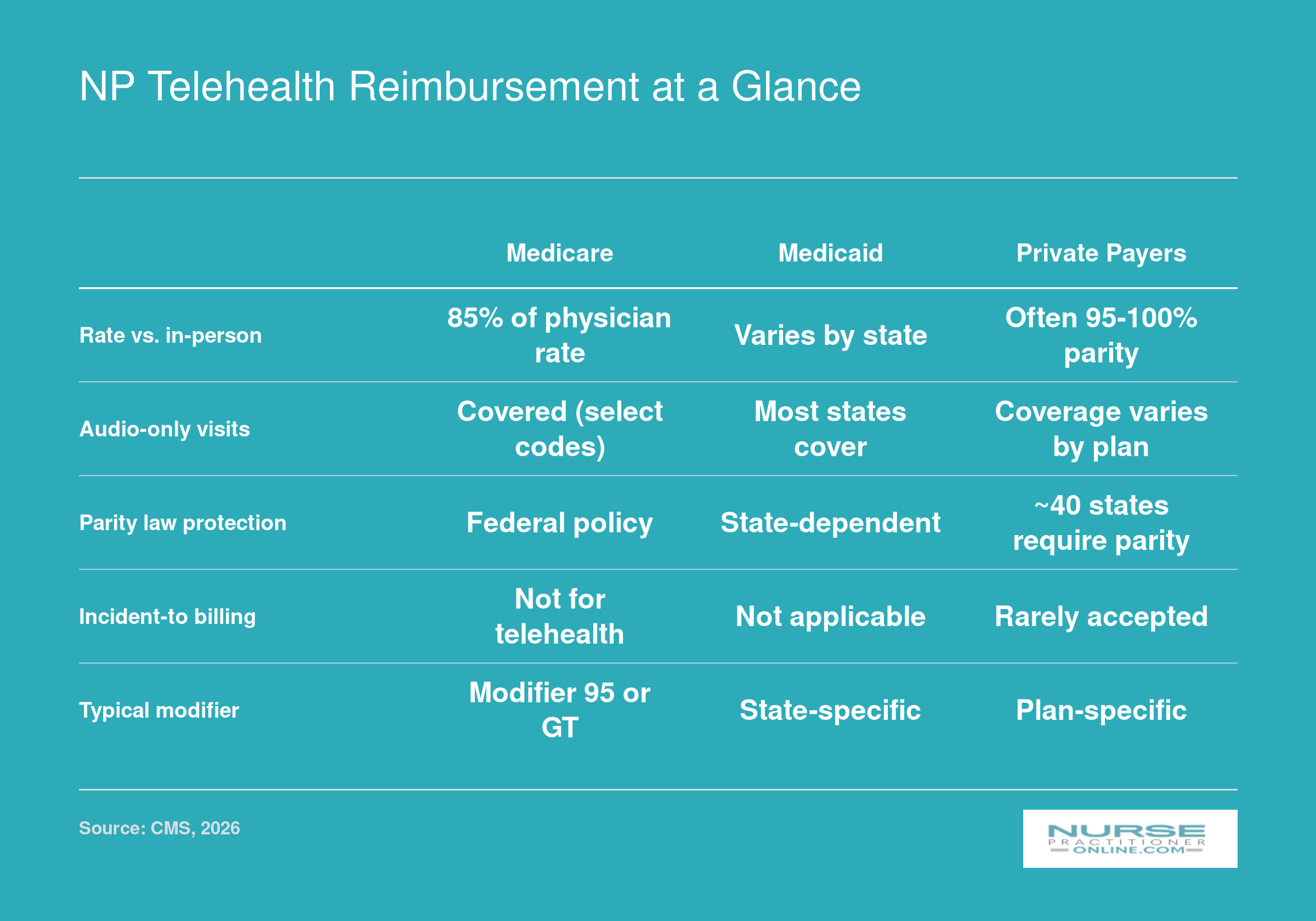
Nurse practitioners are recognized as eligible distant-site practitioners under Medicare, meaning you can bill telehealth visits directly.1 The catch: you are reimbursed at 85% of the physician fee schedule rate, the same statutory differential that applies to in-person NP services.1
Key billing mechanics to know:
- Place of service: Use POS 10 when the patient is at home and POS 02 when the patient is in another non-home location.
- Modifiers: Append modifier 95 for synchronous audio-video visits. Use modifier FQ for audio-only services where allowed.
- Audio-only: Audio-only behavioral health is a permanent Medicare benefit. Audio-only visits for non-behavioral conditions remain covered through December 31, 2027, under the extended telehealth flexibilities.
- Originating site: The patient's home remains an allowed originating site through 2027, and home-based telehealth is paid at the non-facility rate.
- FQHC billing: If you practice in a Federally Qualified Health Center, distant-site telehealth is billed using code G2025.
CMS also removed frequency limits on inpatient, nursing facility, and critical care telehealth visits effective January 1, 2026, which expands how often you can bill for these encounters.2
Medicaid: A State-by-State Patchwork
Medicaid telehealth coverage for NPs varies considerably. Most states now reimburse NP telehealth visits at parity with in-person care, but a minority still pay less or limit covered service types. Before you bill, check your state Medicaid agency's current telehealth policy manual, because coverage of audio-only visits, eligible CPT codes, and originating-site rules differ widely.3
Commercial Payers and Parity Laws
On the commercial side, roughly 20 to 24 states have payment parity laws requiring private insurers to reimburse telehealth at the same rate as in-person visits.3 The rest leave reimbursement to contract negotiation, which often means lower telehealth rates. Many commercial plans also credential NPs separately for telehealth, even if you are already in-network for in-person care. If you want to sharpen your overall claims workflow, our guide to billing for nurse practitioners covers the CPT fundamentals that apply to both virtual and in-person encounters.
Practical Tip Before You Launch Virtual Visits
Verify telehealth credentialing and billing rules with every payer you contract with before seeing your first virtual patient. A quick call to provider services, or a written confirmation of your telehealth status, prevents the most common cause of denials: billing under a credential that does not cover virtual care. For NPs looking to broaden their scope beyond telehealth, exploring nurse practitioner advancement opportunities can help you stay competitive as the landscape evolves.
NP Telehealth Reimbursement at a Glance
Reimbursement for NP telehealth services varies significantly by payer type. Understanding these differences helps you estimate revenue and negotiate contracts, whether you work in a group practice or run your own telehealth clinic.
NP Specialties Driving Telehealth Growth
Not every NP specialty translates equally well to a screen. Some are thriving in virtual care, while others remain tethered to in-person settings by the nature of their work. Understanding which specialties are leading telehealth adoption helps you gauge where the job market is heading and whether your chosen track aligns with remote practice. For a broader look at how different tracks compare, our guide to nurse practitioner specialties is a good starting point.
Psychiatric-Mental Health NPs Lead the Pack
Psychiatric-mental health nurse practitioners (PMHNPs) have seen the most dramatic telehealth uptake of any NP specialty. The American Psychiatric Nurses Association (APNA) and multiple health systems reported that more than 70 percent of mental health visits were conducted via telehealth during 2022 and 2023, and that share has remained high even as other specialties returned to in-person volumes. The reasons are straightforward: mental health care relies heavily on conversation and observation rather than physical examination, reimbursement parity for telehealth mental health services has been sustained in most states, and patient preference for virtual visits is strong. If you're a psych NP or considering that specialty, expect telehealth to be a core competency and a central part of your job description.
Family and Pediatric NPs See Mixed Utilization
Family nurse practitioners (FNPs) and pediatric nurse practitioners (PNPs) have embraced telehealth for follow-up visits, chronic disease management, and urgent triage, but they still perform a substantial share of care face-to-face. The American Association of Nurse Practitioners (AANP) workforce surveys published after 2022 indicate that roughly 40 to 50 percent of FNPs and PNPs report using telehealth regularly, but many reserve it for specific visit types rather than building a fully remote practice. Pediatric care, in particular, often requires physical exams, vaccinations, and developmental assessments that cannot be done virtually. Telehealth in these specialties tends to supplement rather than replace in-person care.
Acute Care and Hospital-Based Specialties Lag Behind
Acute care nurse practitioners (ACNPs), neonatal NPs, and other hospital-based specialties have lower telehealth adoption rates because their work requires hands-on procedures, critical bedside assessment, and real-time coordination with multidisciplinary teams. The American College of Nurse Practitioners (ACNP) has noted growing interest in teleconsult and tele-ICU roles, but these positions remain niche and typically involve collaborating with on-site clinicians rather than delivering direct patient care remotely. NPs interested in telehealth but drawn to acute settings may want to explore non-clinical nurse practitioner jobs such as telehealth program administration or quality oversight.
Where to Find Specialty-Specific Data
The Bureau of Labor Statistics does not break out telehealth usage by NP specialty, but cross-referencing BLS job growth projections with AANP's annual workforce surveys and specialty association reports gives you a clearer picture. If compensation is a factor in your specialty decision, reviewing highest paid NP specialties by salary alongside telehealth adoption data can help you find the sweet spot between earning potential and virtual practice flexibility. State telehealth policy databases and NP program websites sometimes publish case studies or training modules that highlight which specialties are investing most heavily in virtual care infrastructure. For the most current adoption rates, reach out directly to specialty associations, as many conduct member surveys on practice patterns and are willing to share aggregate findings.
Questions to Ask Yourself
Telehealth Practice Models for Nurse Practitioners
Not all telehealth NP roles look the same. How you deliver virtual care, who employs you, and how much autonomy you hold day to day depends heavily on the practice model you choose. Understanding the landscape before you commit to a path can save you from a mismatch between your career goals and your actual working conditions.
Independent Telehealth Practice
NPs with full practice authority in their state can establish their own virtual clinics, set their own hours, and build a panel of patients entirely through video or phone visits. This model offers the highest degree of autonomy and, often, the highest earning ceiling, but it also comes with the full weight of business ownership: credentialing, malpractice coverage, billing systems, and marketing all fall on you.1 The AANP's trend reports consistently show growing interest in independent telehealth models as more states modernize their scope-of-practice laws, though the administrative lift keeps many NPs in employed arrangements instead.2
Employed and Contract Telehealth NP Roles
The majority of NPs practicing telehealth in 2026 do so as employees or independent contractors for healthcare organizations, urgent care platforms, or specialty telehealth companies.1 These roles trade some autonomy for stability: the employer handles credentialing, technology infrastructure, and often multi-state licensing logistics. BLS Occupational Employment Statistics can help you benchmark offers in this space and compare NP compensation across highest paid nurse practitioner specialties before you accept a contract.
Hybrid Practice
Many NPs blend in-person and virtual visits, seeing patients at a brick-and-mortar clinic two or three days a week while running telehealth appointments on the remaining days. This model is popular among primary care and mental health NPs who want the relationship continuity of face-to-face care without giving up the schedule flexibility that telehealth enables.2 Employer perception studies, including those published by the American Medical Group Association, suggest that hybrid arrangements are increasingly viewed favorably by health systems trying to improve access without fully dismantling traditional clinic operations.
Employer-Based and Retail Virtual Clinics
A growing segment of telehealth practice sits inside large employers, health plans, and retail health networks. These roles are typically salaried, protocol-driven, and focused on high-volume, lower-acuity visits.2 They suit NPs who prefer structured environments and predictable caseloads, and they can serve as a useful stepping stone if you are still weighing ways to expand your nurse practitioner career.
Navigating Multi-State Licensing
Whichever model appeals to you, licensing remains a practical constraint. Only four states had passed APRN Compact legislation as of 2025, meaning that cross-state telehealth practice still requires individual state licenses in most cases.3 Resources like Telehealth.org's annual licensure guide and your state licensing board's workforce reports are practical starting points for mapping out what you will need before you can legally see patients across state lines.
NP Telehealth Salary and Job Outlook
The Bureau of Labor Statistics projects 40% job growth for nurse practitioners between 2024 and 2034, far outpacing the 3.1% average for all occupations. This surge reflects growing demand across care settings, including telehealth. The table below provides a national salary snapshot for all NP roles. Keep in mind that BLS figures capture the full NP workforce and do not break out telehealth positions separately. Job board analyses from sites like ZipRecruiter and Doximity suggest that telehealth NP salaries often fall within the same range as in-person roles, though compensation can vary based on specialty, state, payer mix, and whether the position is salaried or per-visit. Some telehealth employers offer competitive pay to attract experienced NPs for remote psychiatric, primary care, or urgent care positions, while per-visit telehealth contracts may result in lower annualized earnings depending on volume. As you evaluate telehealth opportunities, compare total compensation (including benefits and schedule flexibility) rather than base salary alone.
| Metric | National Data |
|---|---|
| Median Annual Wage (May 2024) | $129,210 |
| Mean Annual Wage (May 2024) | $132,000 |
| 25th Percentile Annual Wage | $109,940 |
| 75th Percentile Annual Wage | $149,570 |
| Total Employment | 307,390 |
| Projected Job Growth (2024 to 2034) | 40% |
| Average Projected Growth, All Occupations (2024 to 2034) | 3.1% |
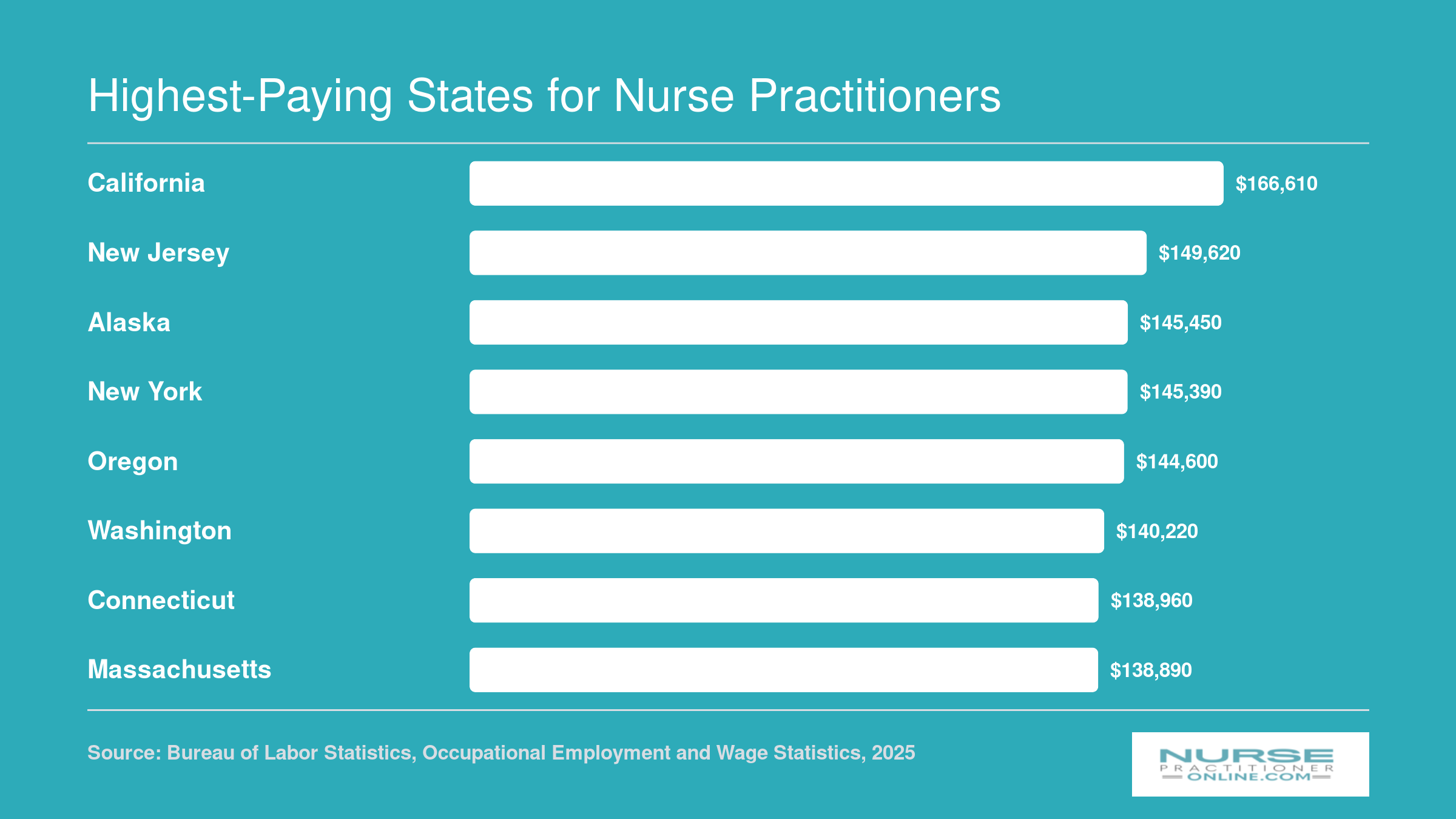
Highest-Paying States for Nurse Practitioners
Whether you're considering a telehealth role or an in-person position, knowing where NP salaries run highest can help you plan your next career move. California leads the nation by a wide margin, followed by several states along the East Coast and Pacific Northwest.
Challenges, Risks, and Equity Considerations in NP Telehealth
Telehealth expansion has opened doors for NPs, but it also introduces legal risks, patient equity gaps, and workflow challenges that can undermine care quality and career stability if ignored.
Legal and Malpractice Risks
Practice across state lines without proper licensure remains a top legal pitfall, and misdiagnosis is the most common allegation in telehealth malpractice claims.1 Recent liability data for NPs shows an average total incurred per claim of $332,137 nationally, with practice owners facing even steeper averages of $431,634.2 Diagnosis-related claims accounted for 37.1% of NP claims, carrying an average severity of $385,947.2 In telehealth specifically, over 70% of allegations are diagnosis-related, and nearly half of all misdiagnosis claims in virtual settings involve cancer or stroke.1 Documentation standards for virtual visits are still evolving, and incomplete notes or failure to document a physical exam equivalent can weaken a defense. Malpractice insurance gaps are also a concern: not all policies automatically cover telehealth, so NPs must verify that their coverage extends to remote care and any cross-state activities.
Patient Equity and the Digital Divide
Broadband access gaps in rural and underserved communities mean many patients cannot participate in video visits, forcing reliance on phone calls that limit assessment quality. Understanding which states need nurse practitioners the most can help contextualize where these gaps hit hardest. Health literacy barriers compound the issue: patients unfamiliar with telehealth platforms may miss appointments, misunderstand instructions, or fail to report key symptoms. If NPs don't intentionally assess technology readiness and offer flexible communication options, telehealth can widen existing disparities rather than close them. Proactive steps like providing plain-language guides, offering interpretation services, and partnering with community sites for internet access are essential to equitable virtual care.
Changing Collaboration Models
In restricted-practice states, supervisory and collaborative agreements take on new dimensions in virtual settings. Familiarity with nurse practitioner scope of practice rules is critical, because communicating with a collaborating physician may rely entirely on asynchronous messaging or EHR notes, which can delay decision-making in time-sensitive situations. Clear protocols for escalation, shared documentation, and periodic virtual case reviews help maintain safety and compliance, but these structures must be explicitly built into the telehealth workflow rather than assumed.
Technology and Workflow Risks
EHR integration challenges, HIPAA compliance for video platforms, and patient identity verification add layers of complexity. Using consumer-grade apps that aren't HIPAA-compliant exposes NPs to privacy breaches and legal liability. Patient identity verification at the start of each visit, through government ID checks or knowledge-based authentication, is critical but often overlooked. Workflow disruptions from poor internet connectivity or platform glitches can erode the therapeutic relationship and increase cognitive load, making it harder to spot subtle clinical cues.
Building Telehealth Competencies: Training and Certification for NPs
Telehealth competency means you can deliver safe, effective virtual care using the right technology, clinical skills, and regulatory knowledge. For nurse practitioners, this includes everything from conducting a video-based assessment to understanding state-specific telehealth laws and documenting encounters appropriately in electronic health records.
Core Competency Frameworks for NP Telehealth
The National Organization of Nurse Practitioner Faculties (NONPF) first published a telehealth position paper in 2018 and updated it in May 2025, reaffirming that all NP graduates should demonstrate basic telehealth proficiency.12 The NONPF framework organizes telehealth competencies into six domains:
- Telehealth clinical skills: Conducting virtual assessments, recognizing when in-person care is needed, and adapting physical exam techniques for remote encounters
- Technology and informatics: Using telehealth platforms, troubleshooting connectivity issues, and integrating remote monitoring data
- Legal and regulatory policy: Understanding state licensing rules, prescribing regulations, and documentation requirements
- Ethics and professionalism: Maintaining privacy, obtaining informed consent for virtual visits, and addressing equity in access
- Communication and patient engagement: Building rapport through a screen, using teach-back methods, and ensuring health literacy
- Systems and quality leadership: Evaluating telehealth outcomes, implementing quality improvement, and advocating for appropriate reimbursement
These competencies are now embedded in NONPF's NP Role Core Competencies, which guide curriculum development at accredited programs.3 A 2021 scoping review in the nursing literature also mapped these domains across education and practice settings, reinforcing the breadth of skills NPs need for virtual care delivery.4
Training and Certification Options
NONPF provides frameworks and faculty resources rather than individual certifications.5 If you want a formal credential, several university-based telehealth certificate programs are available, typically requiring 12 to 20 continuing education hours and costing between $300 and $1,500. Some health systems also offer internal telehealth training that counts toward credentialing.
When evaluating programs, look for curricula that address the NONPF domains and include hands-on simulation or practicum components rather than lecture-only formats. Programs that incorporate nurse practitioner clinical rotations with a telehealth component can be especially valuable for building real-world confidence.
Documenting Your Telehealth Skills
Employers and credentialing bodies increasingly want evidence that you can practice telehealth safely. You can document competency through:
- Continuing education hours from accredited telehealth courses
- Micro-credentials or digital badges from certificate programs
- Clinical hour logs showing supervised telehealth encounters
- Performance evaluations from telehealth-focused preceptorships
A Note for NPs Who Graduated Before 2020
Most NP programs now include telehealth training, but if you completed your degree before the pandemic, your curriculum likely did not cover these skills in depth. Building telehealth competencies independently through CE courses, certificate programs, or employer-sponsored training is a practical way to fill that gap and strengthen your marketability in an increasingly virtual healthcare landscape.
Frequently Asked Questions About NP Telehealth
Below are answers to some of the most common questions nurse practitioners have about telehealth practice. Each response draws on topics covered throughout this guide, so you can quickly find the details most relevant to your career.
- Can nurse practitioners practice telehealth across state lines?
- Generally, NPs must hold a valid license in the state where the patient is located at the time of the visit. Some states participate in the Nurse Licensure Compact (NLC), which simplifies multistate practice. However, the NLC covers RN and LPN licenses, and APRN compact adoption is still limited. Always verify the specific telehealth and APRN licensing rules in both your home state and the patient's state before providing care.
- How do nurse practitioners get reimbursed for telehealth visits?
- Medicare, Medicaid, and most private insurers now reimburse NP telehealth visits, though rates and covered service codes vary by payer. Medicare currently reimburses NPs at 85% of the physician fee schedule for eligible telehealth services. Many states have enacted telehealth parity laws requiring private insurers to reimburse virtual visits at the same rate as in-person care, but coverage details differ. Check each payer's current telehealth billing policies.
- Do nurse practitioners need a collaborative agreement for telehealth?
- It depends on your state. As of 2026, roughly half of U.S. states plus the District of Columbia grant NPs full practice authority, meaning no physician collaboration is required for telehealth or in-person care. In reduced or restricted practice states, a collaborative or supervisory agreement is typically still necessary, and the same rules apply whether care is delivered virtually or face to face.
- Which NP specialties use telehealth the most?
- Psychiatric mental health NPs lead in telehealth adoption, driven by strong demand for behavioral health services and the suitability of talk-based therapy for virtual delivery. Family NPs and adult gerontology primary care NPs also use telehealth extensively for chronic disease management, medication follow-ups, and triage visits. Specialties requiring hands-on assessment, such as acute care or neonatal, tend to rely less on telehealth.
- How has telehealth expansion affected nurse practitioner salaries?
- Telehealth has broadened the job market for NPs, particularly in specialties like psychiatric mental health, where virtual positions often offer competitive or premium compensation. Some NPs earn more by serving patients in higher-paying regions remotely. However, telehealth salaries vary widely depending on the employer, practice model, specialty, and payer mix. Overall, NP salary growth continues to trend upward alongside rising demand for virtual care.
- What telehealth certifications are available for nurse practitioners?
- Several organizations offer telehealth-focused credentials. The American Telemedicine Association provides a certificate program covering best practices in virtual care delivery. The National Consortium of Telehealth Resource Centers offers free training modules. Some universities also offer graduate-level telehealth certificates. While no single certification is universally required, earning one demonstrates competency in digital health tools, virtual clinical workflows, and telehealth compliance, which can strengthen your candidacy for remote NP positions.